Monday, September 3, 2018


Skin Anatomy
Skin Anatomy
The skin is composed of several layers. The very top layer is the epidermis and is the layer of skin you can see. In Latin, the prefix “epi-” means “upon” or “over.” So the epidermis is the layer upon the dermis (the dermis is the second layer of skin). Made of dead skin cells, the epidermis is waterproof and serves as a protective wrap for the underlying skin layers and the rest of the body. It contains melanin, which protects against the sun's harmful rays and also gives skin its color. When you are in the sun, the melanin builds up to increase its protective properties, which also causes the skin to darken. The epidermis also contains very sensitive cells called touch receptors that give the brain a variety of information about the environment the body is in.
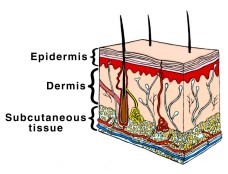
The second layer of skin is the dermis. The dermis contains hair follicles, sweat glands, sebaceous (oil) glands, blood vessels, nerve endings, and a variety of touch receptors. Its primary function is to sustain and support the epidermis by diffusing nutrients to it and replacing the skin cells that are shed off the upper layer of the epidermis. New cells are formed at the junction between the dermis and epidermis, and they slowly push their way towards the surface of the skin so that they can replace the dead skin cells that are shed. Oil and sweat glands eliminate waste produced at the dermis level of the skin by opening their pores at the surface of the epidermis and releasing the waste.
The bottom layer is the subcutaneous tissue which is composed of fat and connective tissue. The layer of fat acts as an insulator and helps regulate body temperature. It also acts as a cushion to protect underlying tissue from damage when you bump into things. The connective tissue keeps the skin attached to the muscles and tendons underneath.
Fantastic facts about the human body
Fantastic Facts about the Human Body
1. Approximately 80-90% of what we perceive as "taste" actually is due to our sense of smell.
2. Your heart beats about 35 million times in a year. During an average lifetime, the human heart will beat more than 2.5 billion times.
3. Your body has about 5.6 liters (6 quarts) of blood. This 5.6 liters of blood circulates through the body three times every minute. In one day, the blood travels a total of 19,000 km (12,000 miles)- that's four times the distance across the U.S. from coast to coast.
4. The heart pumps about 1 million barrels of blood during an average lifetime - that's enough to fill more than 3 super tankers.
5. If all arteries, veins, and capillaries of the human circulatory system were laid end to end, the total length would be 60,000 miles, or 100,000 km. That's nearly two and a half times around the Earth!
6. Even though its thickness averages just 2mm, your skin gets an eighth of all your blood supply.
7. The skull looks as though it is a single bone. In fact, it is made up of 22 separate bones, cemented together along rigid joints called sutures.
8. If a human adult's digestive tract were stretched out, it would be 6 to 9 m (20 to 30 ft) long.
9. Red blood cells may live for about four months circulating throughout the body, feeding the 60 trillion other body cells. Red blood cells make approximately 250,000 round trips of the body before returning to the bone marrow, where they were born, to die.
10. Human hair grows about 1/4 inch (about 6 millimeters) every month and keeps on growing for up to 6 years. The hair then falls out and another grows in its place.
11. The average healthy mouth produces about 600 milliliters of saliva each day. That's enough to fill a 12-ounce soda bottle.
12. The fastest nerve cells are carrying messages along their axons at an amazing 130 yards per second (268mph)
Secret of nail
The nail files: 30 things every woman should know
The nail files: things every woman should know

Women rely upon their nails to accessorise any outfit.
Yet they can also attract bacteria and infection - as well as revealing a great deal about our inner health.
Here, we present the secret nail files . . .
1. Nails are mostly made from keratin, a fibrous protein substance also found in hair. Although fingernails may seem brittle and easily broken, in fact because they are 96 per cent proteins, arranged in lengthwise, twisting strands, their structure is 40 times more resistant to fracture than stone.
2. Nails need to be pliable - if they were too tough they would simply split and crack. It is the presence of fat and water molecules between the layers of keratin that makes flexible as well as shiny.
3. The pink part of the nail is known as the nail bed. This contains the capillaries that bring nourishment to the area just beneath the cuticle, known as the matrix. The matrix is where new cells are generated, making nails grow.
The whole nail, from its white tip to its pink bed, is known as the nail plate, and the crescent moon at its base is called the lunula.
Disease from mouth
Discovering what lives in your mouth
Bacteria give clues to cancer and gum disease
our mouth is a great place for micropests to dwell. Glistening white plateaus, dark crevices, and slimy surfaces boast steamy temperatures of 95 degrees Fahrenheit. The microbes bathe in a saliva-induced humidity of 100 percent, and eat a lavish diet of sugar and other carbohydrates. It’s so lush and varied, researcher Donna Mager refers to it as a mini-jungle. Mager is a fellow in oral medicine at the Forsyth Institute, an independent research institution in Boston. Forsyth scientists, most of whom are on the faculty of the Harvard School of Dental Medicine, have found 615 different species of bacteria – and they’re still counting. “In one mouth, the number of bacteria can easily exceed the number of people who live on Earth,” notes Sigmund Socransky, associate clinical professor of periodontology at Harvard. Years of detecting and identifying mouth tenants have revealed that those living in healthy mouths can be remarkably different from those living in diseased mouths. Some bacteria increase in number, while others decrease. By comparing communities of microbes in healthy people with those in the mouths of those with oral cancer, Mager has found a pattern that she expects will lead to the early diagnosis of oral cancers.
Secrets of human hair
Secrets of human hair unlocked at Natural History Museum in London
Up to 150,000 sprout from each human head. Every strand grows at roughly one centimetre a month, making the gross product per head about 10 miles of hair each year.
After four years or so a strand reaches the end of its life and is shed: each human loses around 50 hairs a day. Uncut, it can reach huge lengths. The world record is held by a Hindu holy man in the late 1940s whose tresses were estimated at seven to eight metres (23ft to 26ft).
It can be cut, bobbed, braided, frizzed, combed out or gathered up. But it can only be artificially extended. Each strand is highly structured from the molecular to the cellular level, says Frédéric Leroy of L'Oréal Research, the sponsor of Hair, a new exhibition at the Natural History Museum in London.
"It is this structure which gives hair its exceptional, even unique properties," he said. "It's very easy to bend it, but very difficult to extend it."
Hair is strong. A single strand could hold 100g (3oz) in weight: the combined hair of a whole head could support 12 tonnes, or the weight of two elephants. Weight for weight, it is not as strong as steel: more like aluminium, or reinforced glass fibres or Kevlar, which is used to make bulletproof vests.
"So nature made these kinds of composite materials long before men could do it," said Dr Leroy.
Hair follicles contain specialised cells called melanocytes which make melanin, the sun-protecting pigment that keeps hair lustrous and coloured.
But these tend to decrease with time, according to Bruno Bernard, the head of hair biology research at Clichy in Paris, which explains the inexorable emergence of silver threads.
The melanin is still there, but not in enough quantities to keep hair from at least seeming grey. And of course there is a widely distributed phenomenon of male pattern baldness which begins with a thinning of the temples and ends with an eventual unsolicited tonsure.
Hair is also home to wildlife: notoriously head lice spread rapidly among schoolchildren. A female will live for a month laying eight eggs a day, according to Chris Lyal, an entomologist at the museum. "It means a fast build-up of lice are quite active, shifting from head to head quite readily. It also means they evolve quite fast, so they can develop resistance to insecticide, for example."
Hair in Asia is more likely to grow thick and long. Hair in Africa is likely to be fine and crinkly, entangling to provide insulation against the fierce sun.
But humans are - compared with their primate relatives - apparently largely hairless. In fact human body hair is so fine that compared with a chimpanzee or gorilla humans appear hairless.
Hair on the head could have survived as protection for a biped that now only walked upright, according to Christophe Soligo, an anthropologist at the museum. It could also serve as a sexual signal. "If my hair is shiny and healthy, I am all shiny and healthy and therefore our kids are going to be shiny and healthy. There are links between reproductive success and attractiveness."
· Hair is at the Natural History Museum, London SW7 from May 29 to September 26
Tongue print
Tongue-Print: A Novel Biometrics Pattern

The tongue is a unique organ in that it can be stuck out of mouth for inspection, and yet it is otherwise well protected in the mouth and is difficult to forge. The tongue also presents both geometric shape information and physiological texture information which are potentially useful in identity verification applications. Furthermore, the act of physically reaching or thrusting out is a convincing proof for the liveness. Despite these obvious advantages for biometrics, little work has hitherto been done on this topic. In this paper, we introduce this novel biometric and present a verification framework based on the tongue-prints. The preliminary experimental results demonstrate the feasibility of the tongue biometrics.
Subscribe to:
Posts (Atom)